
Key changes, what are they all about, and what do they mean for you and your mandolin? Here we’ll cover that by learning a great new song!
You’re probably familiar with the fact that every song has a set key. The key for La Bamba is historically C major. We can choose to play it in any other major key, and even try it in minor keys. Either way, the song is played in that single, elected key. Key changes are when a song has more than one key. Not too mind blowing! But, the sensation a key change produces is remarkable. It can feel you’re on a rollercoaster! Not very mandolin-ish, but a fantastic example of this is at the end of Beyonce’s Love on Top. Give it a listen.
Now imagine, we’re about to learn out to create that feeling with our mandolins!
In this lesson, we’re going to examine how to use chord shapes up and down the neck to funk up our playing. Nothing is cooler than playing chords all over the neck. Not only do you feel like a pro with your fingers sweeping the frets, but you can give each chord a new sound. Let’s face it, playing three-chord songs gets old. Fortunately, you’re a mandolin player and each of your frets is useful and accessible! Additionally, these moveable chords allow for seamless key changes as well. You can deploy the same chord shapes from the initial key in a new area of the neck too, in the new key.
The song in question is the Squeeze classic: Black Coffee in Bed. Not only are the lyrics excellent, but also the tune’s form is complex yet approachable for any player. The verses are keyed in D major, the chorus is in D’s relative minor Bm. That alone is will be fun to observe, but there’s more! The bridge/guitar solo consists of a key change to Eb, which is a half step up from the root key – D major.
Black Coffey in Bed
So, with the help of Black Coffee in Bed, we’ll practice working in major and the relative minor key and a key change!
Let’s get into this thing. Here are the chords that we’ll use:
Verse (D major):
| D | Bm | G | D |
 |  |  |  |
This is the main part of the song. You’re going to play it extensively throughout, so you’ll get a lot of practice! Notice how there are two D chords, you could just play all of the Ds in either chord shape, but if you progress up the neck it is going to give the song a more genuine feeling. Plus, you’ll be working on your chord movements!
So, start with the first position closed D chord, then move up to the closed Bm. Remember, the Bm is the same shape as the first position Am, but a whole step (two frets) up. In the same area of the neck, you’ll move your fingers into the F shape. But this is a whole step up from F, so it’s a G chord. Nothing to it! To finish up the progression you’ll play another D chord, but this time the chord is in the first position A form, on the fifth fret. After you’re finished up with the progression you’ll start again from the first position D chord.
During the verses, each chord progression is played through twice per lyric line. So you play one time through with singing and then play it again without singing. Repeat that throughout the verses.
I love this chord progression. It’s a great warmup because there’s nothing difficult about the strumming pattern so that you can focus on your chord shapes. It’s good to remember that your strumming never has to be intricate. The ear finds a steady beat soothing.
Chorus (B minor):
| Bm | F# | C#m | A |
|  |  |  |
Now we’re ready to switch from the key of D major to the relative minor key, Bm. While not always the case, the first chord of a progression is often the key. This is because it sets the foundation for the ear; establishing what note resolve is found. Music, like life, is often cyclical.
I find it nice to give the first Bm a hardy strum in order to confirm the new key. This is followed by a first position F shape, but since it’s a F# it is performed one half-step up (one fret). Then move to the C#m, played with the closed Am shape. Finally the first position A chord.
This progression for the chorus covers:
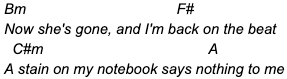
These are some new chords, but there’s nothing to be nervous about. Each chord is a familiar shape! All the while, you’re practicing using the entire mandolin neck.
| D | G7 | A | G |
 |  | | |
The second half of the chorus covers:
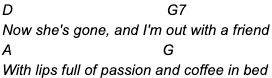
What do you notice about these chords? We’re back to the D major foundation. You see how just as a song can have parts in different keys, even parts of those parts can have new keys!
Pretty straightforward chords here. Except for that G7! No worries though. This chord sounds great in the open, two-finger style. It’s really similar to the two-finger G chord but reversed. Index on the first fret of the E string and middle on the second fret of the A string.
Bridge/guitar solo (Eb/D# major):
| Eb/D# | F | Em7 | A |
 |  |  | |
Now we’re at the key change! This chord progression is only played once through the song, but it’s really what makes the tune stand out from others. All that’s really needed for it is one strum per chord, spaced out by a measure.
For the D# pull out a D shape, one fret up from the normal home of D. Just one strum, it’s all you need. Then the typical F chord. Followed by a frankly difficult chord. You’re going to have to get your fingers like a pretzel. Here’s how it goes:
Em7:
Index finger on the second fret of D the string, middle on the third fret of the E string, ring finger on the fourth fret of the G string, and pinky on the fifth fret of the A string.
It’s a difficult chord! But so were all the other chords when you first learned them. After practicing by forming the chord, then releasing your fingers from the strings and wiggling them out then returning them to the shape, it’ll become second nature.
Finally, finish up the progression with a sigh of relief that it’s only an A chord. Then you’re all done with the key of Eb/D# for this song!
Now for Practicing
Now you know the mechanics of a song with a key change! All there is to do now is practice it to figure out how to play it musically.
Begin with simply memorizing the chord progressions and chord shapes. Then turn on the song and play along to it. Keep in mind that even though the key change to D# is very brief, it will require just as much practice as the rest of the song. Don’t neglect it.
Feel proud of yourself for learning this new song as well as another musical device.
 MandoZen