
What happens when you drop the two most common mandolin techniques into the creative blender of your mind? It’s cross-picking, the ultimate workout in timing, picking, chord formation, and of course multitasking.
It’s practical for any song and sounds beautiful.
What is Cross-picking?
With a head full of closed chords and two finger chords you can strum to just about any song. Add to that your knowledge of picking individual notes through scales and tunes and you’ve got some interesting noises to pull out of the sound-hole(s) of your mandolin. The technique in question is the synthesis of these two approaches to mandolin.
Cross-picking is a picking pattern performed over the chord changes of a song. It is to mandolin what finger-style is to guitar. It brings melody to chords and deep emotion from your instrument.
Why Learn Cross-picking?
Before playing mandolin, I learned guitar. When I was finally able to strum a G, C or Am without buzzing I was in awe. The tone I was able to produce was impressive to me. It didn’t take much.
But with repetition and the cavalierness of a young artist, I became jaded by simple cowboy chord strumming. I wanted to produce new sounds.
Thats when I was exposed to finger-style guitar by my teacher, Jim Steinke.
Finger-style Guitar
It was like being catapulted back to my bedroom on the evening I was awed by those first chords strummed. Finger-style patterns cast provocative shadows off the profile of chords I’d always bathed in harsh light.
I took to it like a Renaissance painter to chiaroscuro.
But I began to notice that everyone and their cousin was playing guitar. It was too much in the collective subconscious of our world. I wanted a niche of my own.
Introducing the Mandolin
Jim had an array of mando-family instruments cast about his studio. He demonstrated classical, bluegrass and Neapolitan tunes using each.
Their shredding and emotional capabilities enamored me. I traded my struggle with guitar for that of mandolin. One of my goals was to accomplish the same finger-style effect on the new instrument. Thankfully Jim was there to show me cross-picking.
Months later, after lots of practice and watching Jim do so, I was able to trade strummed backup chords for cross-picked backup chords. It added depth and intrigue. The cross-picking journey proved every bit as rewarding finger-style.
Here is the Mike Marshall arrangement of Odeon, constructed mostly by one cross-picking pattern. By learning cross-picking this song is accessible for you to emulate. How’s that for a reason to learn the technique?
Short answer to why cross-picking is worth learning is that it will add complexity to what was first simple. Your musical horizon will expand before your eyes.
How to Cross-Pick Patterns
At its heart, cross-picking is just a pattern of picking which fits within a measure of music.
Traditionally, if you’re playing in 4/4 time there will be 8 elements to your pattern. One pluck per quarter note.
That is how we’ll focus our lesson today. Adjustments will have to be made if you’re playing in a different time signature. But 4/4 is common and if you can cross-pick with it you’ll more easily be able to cross-pick in others.
While practicing these patterns begin without holding any chord formations. Keep all the strings open.
Here are your focuses:
- Alternate with a down-pick to an up-pick throughout the pattern.
- Play along to a slow metronome beat, evenly spacing each note.
- Be deliberate with each note, steering clear of sloppiness.
Rest assured that with diligence and focus these patterns will become muscle memory.
Pattern 1:
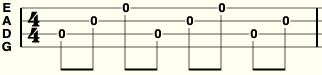
This is the first cross-picking pattern to learn. It is perfect for cross-picking on open-chords covering any of the three higher register strings.
Meaning, the D, A, and E strings. These chords include G, C and Em.
It also works great for the double-stop pattern for C, D, G or A.
Pattern 2:

This is the same pattern as the previous, but it covers the G, D, and A strings. So this is ideal for open chords that incorporate those strings.
For instance, this would be for Am, Bm, or F two-finger chords. It is also great for the double-stop pattern of F.
Note: Pattern 1 and 2 are used together, being used when their times are most useful. So, in a song which has the chords: C, G, Am, F then you could use pattern 1 for the first two chords and then pattern 2 for the last two.
Pattern 3:
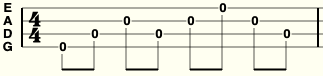
Here is the fist progression which uses all the strings in a measure. Not only does this progression sound great, but it’s also great picking practice.
Pattern 4:
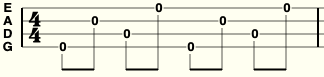
Just like pattern 3, this is a fantastic way to practice with pick accuracy. This is a complicated one because you will be spacing each pluck with a string between. Great way to warm up, as well as use in a jam.
Pattern 5:
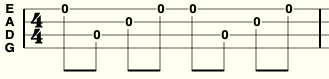
These next two patterns are alike to pattern 1 and 2 in that they are the same patterns but covering different strings. Pattern 5 is the beginning pattern used in the song Odeon featured above.
Pattern 6:

With this pattern you’ll be able to play the other parts to the song Odeon. And of course you will be able to use it for any other sings you’d like to spice up as well.
Cross-Picking with Chords
While cross-picking can be complicated to start, adding in chord changes only adds to the mayhem. However, cross-picking is ideal for two-finger chords. So, that makes it a lot easier than relying on closed-chords as you would while strumming/chopping.
Here is some chords to start with. Try it in the major and the minor keys.
In the key of C the progression would be:
| C | F | G |
 |  |  |
Try each pattern with this major chord progression. Take you time and run through the patter once before moving onto the next.
Master pattern 1 at a slow pattern for all three chords before moving onto pattern two.
Now try the same thing with the minor versions of the previous chords:
| Am | Dm | Em |
 |  |  |
Once you’re feeling really confident attempt to blend the picking patterns. Start with pattern 2. At the chord change switch to pattern 6. Finish it up with pattern 4. It’s up to you!
Cross-picking is the ultimate in multitasking. It’s one of the most effective ways to train your picking hand.
By using cross-picking you learn to play chords while simultaneously picking out notes. It will increase your speed and strength, as well as your ability to pay attention to small details. The more you practice, the better you’ll get.
I hope this lesson was helpful to you.
 MandoZen